Ebony RSW45
A Review by Nick Rains
A Light-Weight 4X5FieldCamera
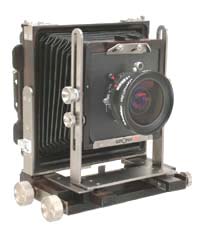
Hats off toRobert Whitein the UK for commissioning this most excellent landscape camera direct from the manufacturer. Made from Titanium and Ebony materials, this camera makes no compromises in quality and rigidity and is available only from Robert White. I acquired one of these cameras recently, mySilvestrioutfit had given me sterling service over the last few years but I longed to be able to shoot more 6×12 on longer lenses. The Silvestri is limited to 100mm without serious modifications so a 4×5 camera with roll film back was the way to go. After much discussion with the hugely knowledgeable Robert, Matt and Jon atRobert White Cameras, I ordered the basic body with enough lens boards to take my existing Schneider lenses – 58XL, 100 Symmar and 150 Symmar. I considered the new 400/5.6 TeleXenar but it is not clear if it will fit and it’s pretty pricey as well. I am now looking for an old 240mm TeleXenar which I know has a very short telephoto design. Back to the camera. The accompanying photos will show clearly the simple and effective design. There is a double rack and pinion system for the film standard and the lens standard. This is smooth, rigid and can be locked firmly in place.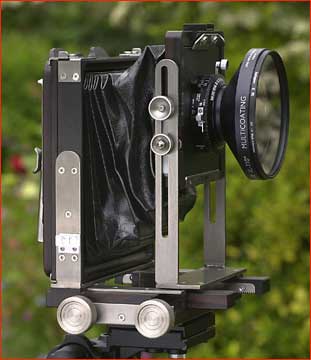
The lens standard has extensive rise and fall as well as a lockable tilt movement. The movements are not as sophisticated as aSinarin that the camera must be refocused after each tilt adjustment but this is to be expected in a camera of this design – it’s a landscape camera not a studio camera. The focusing screen is bright but the downside of this brightness is the fall-off towards the edges is pronounced with the wide lenses. The Silvestri screen has less fall-off but is darker overall. Most people seem to buy the accessory Cambo T20 reflex viewing hood which gives a right-way-up image and is very inexpensive at about GBP120. The only problem with this item is the eyepiece is at 90 degrees to the camera and it is very hard to get your eye to it if the camera is at chest height. 45 degrees would have been much better – perhaps the Horseman viewer would be a better choice.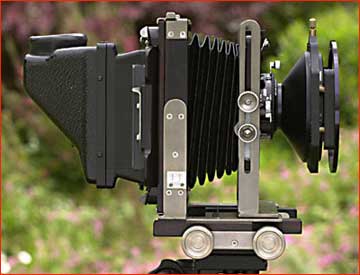
If you have readAlain Briot’sandMichael Johnston’srecent opinions on large format cameras you will be aware of the debate about these types of camera. 4×5 cameras are totally useless for certain sorts of photography, but in landscape photography I fall on the side of Alain in that the extra trouble is simply and completely worth it. I have been places with only 35mm gear and as luck would have it, I found the most amazing scenes – my first thought was always "Bugger – where is my big camera when I need it!" 
Like Alain Briot, I print big. If you don’t print past A3+ like many people, then you don’t need a camera like this. 35mm or the Canon D30 will give wonderful results with less hassle. However, if you do 60" x 30" prints like I do, and you want to sell them, then you have no choice but to shoot 4×5, 6×12 or 6×17. I state this as a simple fact – a 35mm enlarged to these sizes can work, but mostly they just look grainy and soft. No customer is going to pay good money for a print which looks (technically) just like one they themselves could have taken on a normal camera. Shooting large format allows a big print which look so much better than the customers are used to and thus easily justifies the big price tag. Fortunately, the Ebony is quick and easy to use, even for a 4×5. I leave the viewer attached to the camera in my back pack so all I have to do is put it on the tripod, level it and then compose. When ready, just pull off the viewer, add the 6×12 back and shoot. To help things along, I use an EOS3 for metering and I have a Linhof zoom viewer masked off to 6×12 so I can compose a shot before actually getting the camera set up. This is similar to the technique of "lensing" used in the movies – you may have seen directors with little ‘scopes around their necks. One other big advantage of the 4×5 type of camera over the Horseman, Linhof and Fuji 6×12 amd 6×17 cameras it that you can easily see the effect of filters. An optical viewfinder cannot show this and whilst there are workarounds, nothing beats the WYSIWYG approach. Lastly, the Ebony is light, really light. The body only weighs 1.5kg which is similar to an EOS1V. My whole pack with 3 lenses and an EOS3 weighs only about 8-10kg which is very manageable for a decent trek. 
Overall the Ebony is a well designed piece of equipment for the specialist landscape photographer who is really serious about pure technical quality. Nothing beats the feeling of looking at a huge print and being able to almost have to put your nose on the surface to see all the fine detail. People have commented that my prints are "so crisp and clear" as well as being "able to walk right into them". This sort of quality has nothing to do with my creative abilities as a photographer, it is just a technical thing but it is one aspect of photography that is immediately and strikingly obvious to any viewer. The Ebony is the best camera I have used to date and I recommend it’s use to anyone wanting to take that big step up in quality.
Nick Rains
Australia
Nick Rains
Nick Rains has been photographing landscapes all over the world since leaving University in 1983.
In 1986 he spent a year in Perth, Western Australia covering the Americas Cup for a variety of International magazines such as Yachting World, London Times, and Boat International. Images from this event also appeared in Sports Illustrated, Stern, Paris Match, Regatta and many other well known publications.
Over the last 10 years Nick has traveled the length and breadth of Australia covering over 250,000km in his search for fine "Australian" images for the stock photography market. He makes his home in Brisbane, Queensland.
Recent work has been published in Australian Geographic, Outback and GEO (Germany). Nick is now concentrating on photographic books of his favourite places. In between outback trips Nick operates a small studio and shoots commercial and stock photographs at home and overseas.
You may also wish to visitNick’s Web Site, or contact him by e-mail directlyhere.
If you enjoyed this article, as well as the hundreds of other tutorials, features,
reviews and essays on this site, you can support its continued growth
and discover an exciting new photographic resource by …

Michael Reichmann is the founder of the Luminous Landscape. Michael passed away in May 2016. Since its inception in 1999 LuLa has become the world's largest site devoted to the art, craft, and technology of photography. Each month more than one million people from every country on the globe visit LuLa.
You May Also Enjoy...
Vision 11-Critiquing photographs
by Alain Briot He who stands aloof runs the risk of believing himself better than others and misusing his critique of society as an ideology
Sony RX-10 Review
The BasicsThe Sony DSC-RX10 is not exactly what it appears to be.What's that– you say? Well, it's a 20 Megapixel 1" Exmore-R sensor equipped body
